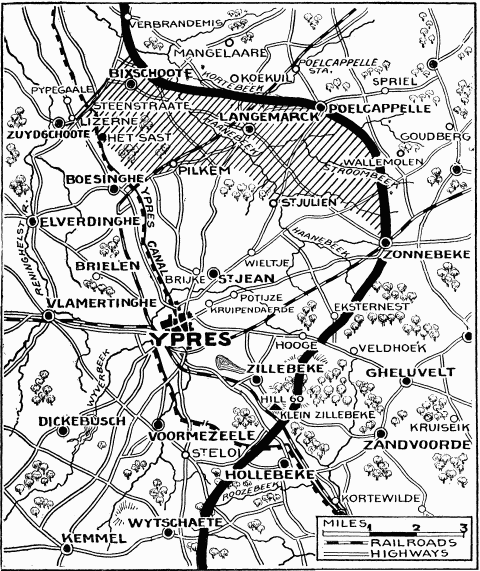
After breakfast and the daily briefing, the group set off for a tour of the Ypres Salient just before 8 am. The salient was formed to the East of Ypres during the early battles (Battle of the Yser and the First Battle of Ypres) in the area in the fall of 1914.
http://www.gutenberg.org/ebooks/15480
Showing the Ypres Salient during the Second Battle of Ypres.
The first stop on this tour was at the Essex Farm Memorial, located to the north of Ypres half way to the town of Boezinge. This cemetery, named after the Essex Regiment, was located adjacent to a Canadian Advanced Dressing Station. It was at this location that medical officer Lieutenant-Colonel John McCrae treated wounded soldiers during the Second Battle of Ypres and wrote his now famous poem In Flanders Fields".
This stone bears the name of V.J. Strudwick. One of the youngest casualties at age 15.
The next stopped occurred near the village of St. Julian, at an intersection called Vancouver Corner. Towering over this location is the Brooding Soldier Monument created by Frederick Chapman Clemesha, an English born architect from Regina and himself a veteran of the war. Erected on 8 July 1923, this eleven meter high granite monument depicts a soldier's head and shoulders, bowed down with his hands in repose, resting on a rifle butt with the rifle's barrel pointing to the ground. The site was selected to commemorate the Canadian 1st Division's action from 22 to 24 April 1915, the beginning of the Second Battle of Ypres, as they withstood the first large scale German gas attack in the history of warfare. It is also a monument that focuses on the notion sacrifice.
Due to the early hour, the sun was not in the best position for a good picture.
The third stop of the day took the tour group to Zoonebeke and the Tyne Cot Cemetery. The name Tyne Cot or Tyne Cottage is attributed to the Northumberland Fussiliers who gave this name to a barn and or some small blockhouses in the area. Tyne Cot Cemetery received its first bodies in the fall of 1917 when the area was captured by the 3rd Australian Division and the New Zealand Division. After the war it was enlarged by concentration graves form other, smaller cemeteries in the area,
becoming the final resting place of nearly 12 000 Commonwealth soldiers, about 8 000 of whom are unknown.
The northeastern boundary of the cemetery is marked by the Tyne Cot Memorial to the Missing, a
semicircular wall that bears the names of almost 35 000 names of war dead from Great Britain and New Zealand. The names of the British soldiers were initially supposed to be inscribed at the Menin Gate but it turned out that there was not sufficient space. As a result, those who died after 15 August 1917 were commemorated at the Tyne Cot Memorial. The centre of the wall was chosen for the New Zealand Memorial Apse, one of three larger memorials to commemorated the approximately 5 000 New Zealanders who gave their lives in the Ypres Salient.
One of the interesting discoveries for many in the group was the fact that families could select the epitaph included on the stone for their loved one.
These are two very personal ones that stand out from most of the others that seem almost formulaic.
The first one reads: “Would Some thoughtful hand in this distant land please scatter some flowers for me.”
The second: “Sacrificed to the fallacy that war can end war.”
After the Tyne Cot Cemetery we did a short, unplanned stop at the Passchendaele Memorial.This interesting aspect of this site was how integrated it (but also many others) was into the daily live of the local community as a pasture with two horses was located right at the edge of the park area.
After leaving the Ypres Salient, the tour group crossed the border, leaving Belgium and entering France and had a short stop for lunch in the town of Arras, capital of Pas-de-Calais, which dates back to Roman times.
After lunch the next stop was the Beaumont-Hamel Newfoundland Memorial Park located about 30 km south of Arras. The park commemorates the sacrifices made by the Newfoundland Regiment 1 July 1916, the first day of the Somme offensive. Ordered out of their trenches as the third wave of attack around 9:15am, most men of the regiment were killed or injured before they even reached No Man's Land. Of the once almost 800 men strong regiment fewer than 70 had survived uninjured.
One of the defining commemorative features of the park is a bronze caribou (the regiment's emblem) overlooking the rolling fields, gazing in the direction of the former enemy.
(Vinyl Ridge from a distance as it is part of day 4.)
For more information on the Newfoundland Regiment's engagement during the first day of the Battle of the Somme see:
https://www.heritage.nf.ca/first-world-war/articles/beaumont-hamel-en.php
The final stop of the day had the group visit the Thiepval Memorial and Visitor Centre, located just a few kilometres from Beaumont-Hamel on the eastern side of the Ancre, a Somme tributary. The Thipval Memorial bears the names of over 72 000 men from the British and South African forces who died in the Somme sector between 1 July 1916 and 20 March 1918 and who have no known grave.
The visit to Thiepval concluded the site visits for Day 3 and had the group return to Arras for dinner and an overnight stay.


